Applying online is often part of a job search, but it should not be your only strategy. Many qualified candidates submit applications and then wait, hoping their materials will move forward. A stronger approach is to combine a targeted application with professional outreach to the people involved in hiring.
If you have ever wondered how to contact hiring managers directly without coming across as aggressive, the answer is simple: lead with relevance, respect their time, and make your message easy to respond to. Done well, direct outreach can help you stand out, show initiative, and create a real human connection behind your resume.
This article covers practical job search outreach tips you can use across the United States, whether you are pursuing a new role, changing careers, or re-entering the workforce. You will learn when direct outreach makes sense, how to identify the right contacts, what to say, and how to follow up professionally.
Why Direct Outreach Still Matters in a Modern Job Search
Job postings can attract hundreds of applicants. Even when your background is strong, it is easy for your application to blend into a crowded field. Networking with hiring decision makers gives you another path to demonstrate fit and interest.
Reaching out directly does not mean bypassing the application process. In most cases, you should still follow the employer’s instructions and apply through the appropriate channel. The difference is that you also make a thoughtful introduction to the person who may influence the decision.
Direct outreach can help you:
- Show genuine interest in a specific role or employer
- Highlight a few qualifications that match the opening
- Create name recognition before interviews are scheduled
- Build relationships that may help with future openings
- Demonstrate communication skills and initiative
The key is tone. Hiring managers are busy. If your message is self-focused, demanding, or too long, it may be ignored. If it is concise, relevant, and professional, it can make a positive impression.
Know the Difference Between Confident and Pushy
Many job seekers avoid contacting employers because they do not want to seem intrusive. That concern is understandable, but it helps to define what actually makes outreach feel pushy.
Confident outreach is:
- Brief and specific
- Respectful of the recipient’s time
- Focused on fit and value
- Polite in asking for consideration or insight
- Limited to reasonable follow-up
Pushy outreach is:
- Repeated messages in a short time
- Demands for an interview or immediate response
- Long, unfocused career summaries
- Guilt-based language such as asking why no one has replied
- Attempts to force personal contact through multiple channels at once
Your goal is not to pressure someone into responding. Your goal is to make it easy for them to see who you are, what role interests you, and why your background may be relevant.
When It Makes Sense to Email a Hiring Manager About a Job
Not every situation calls for direct outreach, but many do. In general, it makes sense to email a hiring manager about a job when:
- You have applied for a clearly defined opening and want to express targeted interest
- You found the role through LinkedIn, a company website, or a referral
- Your experience closely aligns with the position requirements
- You have a mutual connection, shared industry association, or referral source
- You are exploring opportunities at a company that regularly hires your type of background
It may be less effective to reach out when you have no clear connection to the role, no understanding of the employer’s needs, or no meaningful reason for contacting that specific person. In those cases, you may need to do more research first.
How to Find the Right Hiring Contact
One of the most important job search outreach tips is to contact the right person. Sending a message to the wrong employee can waste time or create confusion.
Start with these sources:
Search for the company, then review employees with titles such as hiring manager, department manager, director, recruiter, talent acquisition, or team lead. If the job is in marketing, for example, a marketing director or senior manager may be the right target.

Company Website
Look at leadership pages, staff directories, media releases, and department descriptions. Smaller organizations may list the exact manager responsible for the function you want to join.
Your Network
Ask colleagues, alumni, former managers, vendors, or professional association contacts whether they know someone at the company. Warm introductions can improve response rates.
Industry Events and Webinars
Virtual and in-person events often reveal who leads a team or makes staffing decisions. A brief follow-up after hearing someone speak can be appropriate if your message is thoughtful.
If you cannot identify the exact hiring manager, contacting an internal recruiter or talent acquisition professional can still be worthwhile. Just tailor the message to their role.
What to Do Before You Reach Out
Effective outreach starts before you write a message. A hiring manager is more likely to notice you if your materials and positioning are clear.
Before contacting anyone directly, make sure you have:
- A current resume tailored to the role or target type of role
- A LinkedIn profile that supports your experience and career direction
- A clear understanding of the company, team, or industry
- A short statement of your value based on the employer’s likely needs
- A professional email address and appropriate voicemail greeting
This preparation matters because if your message leads someone to review your profile or resume, you want the impression to be consistent and credible.
How to Structure a Direct Outreach Message
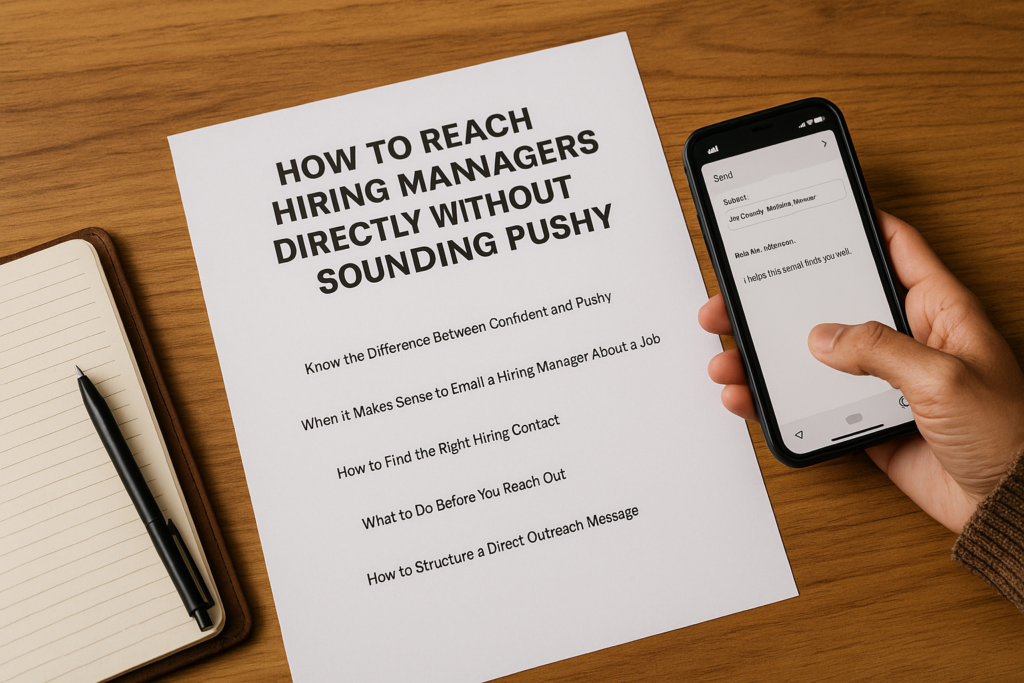
If you want to know how to contact hiring managers directly in a way that feels natural, use a simple structure:
- Write a clear subject line
- Open with the reason for your message
- Show that you understand the role or organization
- Mention two or three relevant qualifications
- Close with a low-pressure next step
A strong outreach email does not repeat your entire resume. It gives a quick reason to pay attention and makes it easy for the reader to decide whether to reply.
Subject Line Examples
- Application for Project Manager Role
- Interest in Your Operations Manager Opening
- Experienced Sales Leader Reaching Out Regarding Regional Role
- Following Up on Marketing Specialist Application
Avoid vague or gimmicky subject lines. Clarity works better than cleverness.
Opening Examples
Your first sentence should quickly explain why you are writing. For example:
- I recently applied for your customer success manager opening and wanted to introduce myself directly.
- I am reaching out because your posted finance manager role aligns closely with my background in budgeting, reporting, and cross-functional planning.
- I enjoyed hearing your panel discussion on healthcare hiring trends and wanted to connect regarding future operations opportunities on your team.
These openings are direct without sounding demanding.
Example: Strong vs. Pushy Outreach
| Approach | Example | Why It Works or Fails |
|---|---|---|
| Professional | I applied for the role and wanted to briefly introduce myself. My background includes five years of logistics coordination and process improvement in multi-site operations. If helpful, I would welcome the chance to discuss how my experience may align with your team’s needs. | Clear, relevant, and respectful. It highlights fit without pressuring the recipient. |
| Pushy | I submitted my application last night and have not heard back. Please let me know when you can interview me this week. I am confident I am the best candidate. | Demanding tone, unrealistic timing, and self-focused language can create a negative impression. |
Sample Email Hiring Manager About Job Opening
Here is a simple template you can adapt:
Subject: Application for [Job Title]
Hello [Name],
I recently applied for the [Job Title] position and wanted to introduce myself directly. I am very interested in the opportunity because [specific reason tied to the company, team, or work].
My background includes [two or three relevant strengths or achievements]. In my recent work, I have [brief example of relevant contribution or responsibility]. Based on the position description, I believe my experience could align well with your team’s needs.
I understand you may be receiving many applications, but I wanted to express my interest and share my resume for convenient reference. Thank you for your time and consideration.
Best regards,
[Your Name]
[Phone]
[LinkedIn URL if appropriate]
This format is effective because it is short, personalized, and easy to scan.
How to Personalize Without Overdoing It
Personalization improves your odds of being noticed, but too much can feel forced. You do not need to write a mini biography of the hiring manager or mention every company update you found online.
Good personalization may include:
- Referencing the exact role
- Mentioning a recent company initiative relevant to the position
- Noting a mutual contact or shared professional group
- Connecting your background to a visible business need
For example, if a company recently expanded into a new market and you have experience supporting similar growth, that is a useful connection to make. It shows you have done your homework and are thinking about the employer’s needs, not just your own goals.
Best Practices for Networking With Hiring Decision Makers
Networking with hiring decision makers is not limited to cold email. It includes thoughtful relationship-building across several settings.
Use LinkedIn Carefully
Connecting on LinkedIn can be appropriate, especially if you add a short note. Keep it simple. Mention the role, shared industry, or reason for connecting. Do not paste a full cover letter into a connection request.
Ask for Insight, Not Favors
When appropriate, ask a contact for perspective on a team, business challenge, or hiring process rather than immediately asking them to get you an interview. People are generally more receptive to reasonable questions than direct pressure.
Be Visible in Relevant Spaces
Industry groups, alumni networks, trade associations, webinars, and conferences can all help you become more familiar to people in your field. Thoughtful participation can make later outreach feel warmer.
Stay Professional Across Channels
If you email someone, avoid sending the same message through LinkedIn, voicemail, and social media on the same day. That can feel excessive. Choose one primary channel, then follow up appropriately later if needed.
How Long to Wait Before Following Up
Following up is reasonable. Repeated nudging is not.
A practical rule is to wait about five to seven business days before sending a brief follow-up if you have not received a response. If you still hear nothing, one more follow-up after another week may be acceptable. After that, it is usually best to move on while keeping the door open for future opportunities.
Your follow-up can be very short:
Hello [Name],
I wanted to follow up on my earlier message regarding the [Job Title] opportunity. I remain very interested and believe my background in [brief relevant area] may be a strong match. Thank you again for your time.
Best regards,
[Your Name]

This keeps the interaction professional and low pressure.
Common Mistakes That Undercut Outreach
Even strong candidates can weaken their message through avoidable errors. Watch for these common mistakes:
Writing Too Much
Long emails often go unread. Keep your outreach concise enough to scan quickly on a phone or between meetings.
Being Too Generic
If your message could be sent to any employer in any industry, it will not stand out. Include specifics that show real interest and fit.
Leading With Need Instead of Value
It is understandable to want a new job quickly, but your message should focus on what you can contribute, not on how urgently you need a response.
Ignoring Basic Professionalism
Typos, casual slang, or unclear formatting can create doubt about your attention to detail. Review everything before you send it.
Contacting Too Many People at Once
Mass outreach within the same company can backfire. It may look disorganized or overly aggressive. Identify one or two appropriate contacts instead.
How to Reach Out During a Career Change
If you are changing industries or functions, direct outreach can be especially helpful because your resume may not immediately tell the whole story. In that case, your message should bridge the gap clearly.
Focus on transferable value, such as:
- Leadership and team management
- Project coordination
- Client communication
- Process improvement
- Training and mentoring
- Compliance, documentation, or reporting
State directly why you are making the change and why your experience still applies. Hiring managers do not want a long justification. They want a clear business case for considering you.
For example, if you are moving from education to corporate training, you might briefly note your experience designing curriculum, presenting to varied audiences, and measuring learning outcomes. That helps the reader connect your background to their needs.
Align Your Resume and Outreach Message
Your message may open the door, but your resume and LinkedIn profile need to support what you say. If you tell a hiring manager you are a strong fit for a role, your materials should make that logic easy to see.
Make sure your outreach aligns with:
- Your target job title or direction
- The keywords and priorities in the posting
- Your most relevant achievements
- Your professional summary and LinkedIn headline
Mixed messaging creates friction. Consistency builds trust.
What Results to Expect From Direct Outreach
Direct outreach is not a magic shortcut, but it can be a smart part of a broader strategy. Sometimes a hiring manager will reply quickly. Sometimes they will forward your information internally. Sometimes there will be no response at all, even if your message was well written.
That does not mean the effort was wasted. Professional outreach can improve visibility, reinforce your application, and expand your network over time. It works best when paired with strong job search materials, thoughtful targeting, and steady follow-through.
Think of outreach as one tool among several. Apply strategically. Network consistently. Tailor your documents. Prepare for interviews. Taken together, these actions create a stronger overall campaign than simply submitting applications and waiting.
Build a Direct Outreach Strategy You Can Repeat
The most effective candidates use a repeatable process rather than improvising every message from scratch. A practical system might look like this:
- Identify target roles and companies
- Tailor your resume to the opportunity
- Apply through the employer’s preferred method
- Find one appropriate hiring contact
- Send a brief, personalized message
- Track outreach dates and responses
- Follow up once or twice if appropriate
- Continue building related networking connections
This approach helps you stay organized and professional while avoiding over-contact or rushed messaging.
Conclusion
Learning how to contact hiring managers directly is not about being aggressive. It is about being clear, relevant, and respectful. When you reach out with a focused message, demonstrate genuine fit, and follow up appropriately, you show initiative without sounding pushy.
In a competitive market, thoughtful outreach can help employers connect your name, experience, and interest more quickly than an application alone. The strongest results usually come when your email, resume, LinkedIn presence, and overall strategy are aligned.
If you want better results from direct outreach, start by tightening your message and targeting the right people. A well-positioned candidate with clear materials and professional communication is far more likely to make a strong impression than someone who relies only on online applications.