Applying for jobs online can feel efficient at first. You find openings, upload your resume, answer the same questions over and over, and wait. Then nothing happens. No interview request. No rejection email. Just silence.
If that sounds familiar, you are not alone. Many qualified candidates struggle with applying online no response situations, especially when they rely too heavily on job boards and submit the same resume to every posting. In many cases, the issue is not a lack of experience or ability. It is a weak or incomplete job search strategy.
A productive search usually requires more than clicking “Apply.” It involves targeting the right roles, tailoring your documents, presenting your value clearly, and finding ways to reach decision makers beyond the application portal. A strong job search plan helps you focus your effort where it is most likely to create traction.
Below is a practical approach to rebuilding your strategy if you are applying consistently and getting little or no response.
Why Online Applications Often Lead to No Response
Before you change your approach, it helps to understand why employers are not responding. Silence does not always mean you are unqualified. It may reflect how employers manage volume, evaluate applicants, and prioritize referrals.
High application volume
Popular job postings can attract hundreds of applicants. Hiring teams may review only a portion of those applications closely, especially when they identify enough promising candidates early in the process.
Generic resumes and cover letters
If your resume looks broad, outdated, or disconnected from the specific role, it is easier for a recruiter to move on. Employers want to see alignment between your background and their needs. A generalized resume often hides that alignment instead of highlighting it.
Weak positioning
Many candidates describe job duties instead of business value. Employers are trying to solve problems, fill capability gaps, and reduce risk. If your materials do not show results, scope, specialization, or relevant strengths, your application may not stand out.
Keyword mismatch
Many employers use application systems to organize and search applicants. If your resume does not reflect the language used in the posting, your materials may be harder to find or evaluate efficiently. This does not mean stuffing in terms unnaturally. It means describing your experience in language the employer recognizes.
Overreliance on job boards
Job boards are useful, but they are only one channel. If your entire search depends on online applications alone, you may be competing in the most crowded part of the market while ignoring networking, direct outreach, and referral opportunities.
Applying to the wrong roles
Some candidates apply too broadly out of frustration. That usually lowers response rates. If you are pursuing positions that do not fit your recent experience, target level, industry background, or location requirements, you may be investing time in openings that were unlikely to move forward.
What a Better Job Search Strategy Looks Like
A stronger job search strategy combines targeted applications with proactive outreach and clear weekly goals. Instead of measuring progress only by the number of applications submitted, measure it by the quality of your targeting and the number of real conversations you create.
| Approach | Passive Search | Strategic Search |
|---|---|---|
| Resume use | Same resume for every role | Tailored resume for target positions |
| Application method | Mostly job boards | Job boards plus direct outreach and networking |
| Targeting | Broad, inconsistent | Focused on fit, level, industry, and goals |
| Follow-up | Little or none | Professional, selective follow-up |
| Success measure | Number of applications | Interviews, contacts, referrals, and momentum |
The goal is not to apply everywhere. The goal is to create a repeatable system that makes it easier for the right employers to recognize your fit.
Step 1: Define Your Job Target Clearly
If your search lacks focus, start here. A vague objective leads to vague applications.
Choose one or two target role categories based on your strongest and most marketable experience. For example:
- Project Manager in healthcare operations
- Regional Sales Manager in industrial distribution
- Human Resources Generalist with employee relations focus
- Financial Analyst in corporate FP&A
Then clarify the following:
- Your target job titles
- Your strongest industries
- Your preferred seniority level
- Your geographic flexibility within the U.S.
- Your must-haves and deal-breakers
This focus will improve your resume, your LinkedIn profile, your outreach messages, and your decision-making. It also helps you identify when a posting is a strong fit versus a long shot.
Step 2: Audit Your Resume for Relevance, Not Just Accuracy
Many resumes are accurate but ineffective. They list jobs and responsibilities without making a persuasive case.
Review your resume through an employer’s eyes. Ask:
- Does the top third of the first page show who I am and what I offer?
- Does my resume match the type of role I am pursuing now?
- Are the most relevant achievements easy to find?
- Do bullet points emphasize outcomes, scope, and contribution?
- Am I using current terminology that employers in my field expect?
If your resume opens with a vague objective or dense paragraph, tighten it. Replace generic language with specifics. A strong summary should communicate your direction, experience level, and core strengths quickly.
For example, compare these two approaches:
Weak: “Results-oriented professional with strong communication skills seeking a challenging opportunity.”
Stronger: “Operations leader with experience improving workflow, vendor coordination, and team performance in multi-site service environments.”
Your bullet points should also go beyond task lists. Instead of only saying what you were responsible for, show what changed because of your work. Use plain, credible language and quantify when it adds clarity.
Step 3: Tailor Your Resume to the Job Posting
If you are submitting the same resume to every opening, your response rate will usually suffer. Tailoring does not require a total rewrite each time, but it does require adjustment.
For strong-fit roles, customize:
- Your headline or summary
- Key skills or areas of expertise
- The order of bullet points under recent positions
- Relevant keywords from the posting
- Selected accomplishments that align with the employer’s priorities
Suppose one position emphasizes cross-functional leadership and process improvement, while another emphasizes client relationships and revenue growth. Even if both roles fit your background, the strongest version of your resume for each one should highlight different aspects of your experience first.
This is one of the most practical ways to improve results when you are applying online and getting no response.
Step 4: Upgrade Your LinkedIn Presence
Your LinkedIn profile should support your resume, not contradict it or lag behind it. Recruiters and hiring managers often check LinkedIn after seeing an application or before responding to outreach.
Focus on these areas:
- A clear headline that reflects your target role or specialty
- An “About” section that summarizes your value and direction
- Experience entries that reinforce your resume’s strongest themes
- Skills that match the work you want to do
- A professional photo and complete profile information
You do not need to turn LinkedIn into a personal branding performance. You do need a profile that makes sense, supports your target, and helps people understand your background quickly.
Step 5: Stop Relying on Applications Alone
One of the biggest reasons candidates feel stuck is that they mistake activity for strategy. Submitting dozens of applications may feel productive, but if that is your only method, you may be spending most of your time in the least personal part of the process.
Add these channels to your job search plan:
Networking
Reach out to former coworkers, managers, clients, vendors, classmates, and professional contacts. Let them know what type of role you are targeting. Keep the message concise and specific. People are more likely to help when they understand what you are looking for.
Recruiter outreach
For roles and industries where recruiters are active, identify appropriate recruiters and introduce yourself professionally. Share a brief summary of your background and target. Do not send a generic mass message.
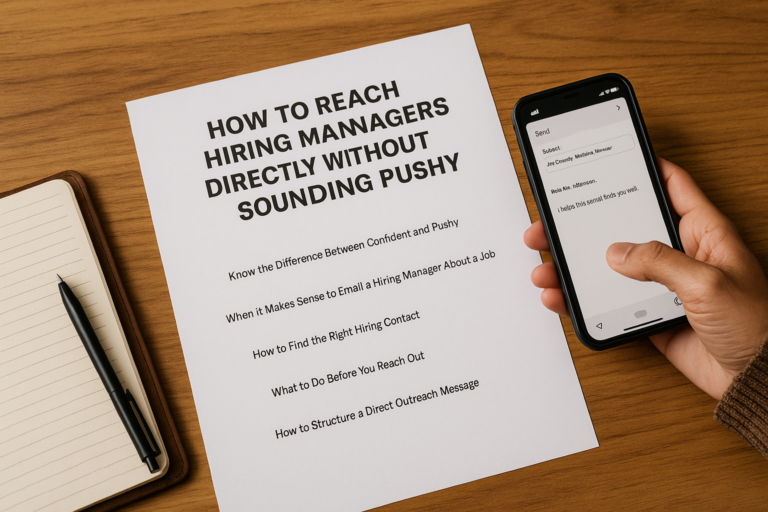
Hiring manager outreach
When appropriate, contact hiring managers or department leaders directly. This works best when your message is respectful, relevant, and tied to a specific opening or business need.
Direct employer targeting
Make a list of employers that fit your goals, even if they do not have the perfect opening posted today. Follow their career pages, monitor their growth, and look for opportunities to make informed contact.
The purpose of these efforts is not to bypass every process. It is to complement the online application with visibility and context.
Step 6: Build a Weekly Job Search Plan
A strong job search plan turns good intentions into consistent action. Without structure, it is easy to either apply impulsively or lose momentum.
Create a weekly schedule with categories such as:
- Targeted applications
- Resume tailoring
- LinkedIn updates
- Networking outreach
- Recruiter contact
- Follow-up messages
- Interview preparation
- Research on target employers
For example, a week might include:
- 5 to 10 highly targeted applications
- 10 networking or reconnect messages
- 3 recruiter or hiring manager outreach messages
- 1 hour of LinkedIn and resume refinement
- 1 hour of interview story preparation
The exact numbers depend on your field, schedule, and career level. What matters is consistency, targeting, and a balance between application activity and relationship-building.
Step 7: Use Follow-Up Thoughtfully
Follow-up can help, but only when done professionally. Repeated messages sent too quickly can hurt your impression.
Consider following up when:
- You applied for a role that strongly matches your background
- You have a relevant point of contact
- You were referred by someone internally
- You previously connected with the recruiter or hiring manager
A brief message can reaffirm interest and point to your fit. Keep it short. Mention the role, express interest, and note one or two relevant qualifications. If you do not receive a reply, move on rather than chasing repeatedly.
Step 8: Track Results and Adjust Based on Evidence
If your current process is not working, guessing will not fix it. Tracking helps you identify where the problem really is.
Use a spreadsheet or simple tracker to record:
- Company name
- Job title
- Date applied
- Source of opening
- Whether your resume was tailored
- Outreach completed
- Follow-up date
- Response or outcome
After a few weeks, patterns will emerge. For example:
- If tailored applications perform better than generic ones, keep prioritizing quality over volume.
- If networking conversations produce more leads than job boards, expand that effort.
- If you get interviews for one role category but not another, refine your target.
- If you get recruiter calls but no interviews, strengthen your interview preparation.
This is how a frustrating search becomes a manageable process.
Step 9: Reassess If You Are Still Hearing Nothing
If you have made these improvements and are still seeing no traction, step back and evaluate more deeply. The issue may involve one or more of the following:
- Your target roles may be unrealistic for your recent background.
- Your resume may still not communicate value clearly.
- Your experience may need stronger positioning for a career change.
- Your application materials may be too broad or too dated.
- Your search may not include enough direct outreach.
- Your salary expectations may be misaligned with the market.
This is often the point where outside perspective becomes useful. A skilled resume writer or job search coach can help identify blind spots, strengthen your materials, and build a more effective approach.
Practical Examples of Strategic Changes
Here are a few realistic shifts that can improve momentum:
Example 1: The high-volume applicant
A candidate applies to 75 jobs using one resume and hears almost nothing. After narrowing the target to one role family, tailoring the summary and top bullets for each application, and contacting former colleagues, the candidate begins generating more relevant conversations.
Example 2: The career changer
A professional wants to move into a related field but keeps applying as if the transition is obvious. Reframing the resume around transferable skills, relevant projects, and matching terminology helps employers understand the fit more clearly.
Example 3: The experienced professional with an outdated presentation
A strong candidate has deep experience but a resume that reads like a long chronology of duties. Modernizing the format, tightening the summary, and highlighting measurable achievements makes the value proposition easier to grasp.
In each case, the problem is not necessarily the candidate’s capability. It is the communication strategy and search method.
Important Mindset Shifts During a Slow Search
Silence from employers can become discouraging quickly. It is easy to assume something is fundamentally wrong with you or your background. Usually, a lack of response is better understood as a signal that your strategy needs adjustment.
Keep these mindset shifts in mind:
- Do not equate volume with effectiveness. Ten strong applications can outperform fifty weak ones.
- Do not let frustration drive random applying. Broad, unfocused activity often lowers results.
- Do not rely on hope alone. A real system creates better odds than repeated blind submission.
- Do not take every non-response personally. Hiring processes are often inconsistent, delayed, and crowded.
What you can control is your targeting, presentation, outreach, and follow-through.
Conclusion
If you are stuck in a cycle of applying online no response, the answer is usually not to apply faster. It is to search more strategically.
A stronger job search strategy starts with a clear target, tailored materials, a credible LinkedIn presence, and outreach that goes beyond job boards. It also requires a structured job search plan that helps you measure what is working and adjust what is not. When you understand why employers are not responding, you can stop guessing and begin making purposeful improvements.
The most effective job searches are not built on volume alone. They are built on relevance, clarity, consistency, and direct effort to connect with the right opportunities.